Overtone
Physiological+control+systems+solutions+manual+michael+khoo+link -
The book covers mathematical modeling, static analysis, dynamic analysis, frequency-response analysis, and stability analysis of biological control systems.
Engineering models use known components, whereas biomedical engineers must estimate unknown biological parameters from experimental data. Key Topics Covered in the Curriculum
: Look for textbooks on physiological control systems or biomedical engineering that might include solutions manuals or study guides. Online libraries and bookstores like Amazon, Google Books, or university libraries may have what you're looking for.
Faculty teaching biomedical engineering courses usually have direct access to the publisher-verified solution steps and can walk you through the logic behind difficult problems.
It delves into feedback control mechanisms in physiological regulation, such as cardiovascular regulation, respiration, and thermoregulation. Online libraries and bookstores like Amazon, Google Books,
Ensuring your derivations and simulations are accurate.
Search GitHub for khoo-solutions or physiological-control-systems . You will rarely find the official manual, but you will often find student-written LaTeX solutions to specific chapters. These are legally safer than a random PDF link. Students in biomedical engineering programs at USC, Boston University (Khoo’s home institution), and Johns Hopkins often share collaborative answer keys.
: The book covers classical control theory applied to physiological systems, including mathematical modeling, time-domain and frequency-domain analysis, stability analysis, and nonlinear dynamics. University of Nottingham Accessing the Solutions Manual
If you are struggling with the problem sets in Michael Khoo's textbook, consider the following authorized avenues for assistance: Ensuring your derivations and simulations are accurate
The textbook is published by Wiley-IEEE Press . Students should first look for official companion websites associated with the second edition.
Estimating unknown physiological parameters using experimental input-output data.
The solutions manual mirrors the textbook's structure, offering analytical answers to problems across major physiological domains: 1. Mathematical Modeling
Because the course material heavily bridges complex biology with mathematical engineering, access to the solutions manual is critical for mastering the problem sets at the end of each chapter. Understanding the Role of the Solutions Manual Boston University (Khoo’s home institution)
However, many students often find themselves searching for the solutions manual
The textbook Physiological Control Systems: Analysis, Simulation, and Estimation
Navigating Physiological Control Systems: A Guide to Michael Khoo’s Classic Text
Examples
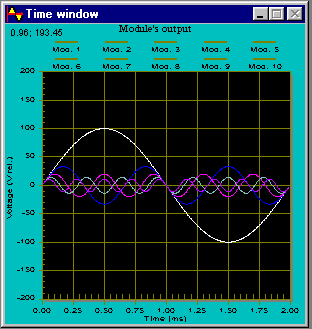
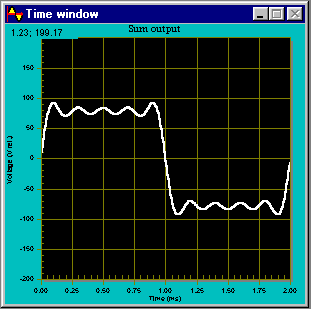
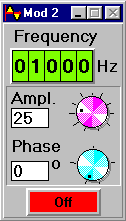
You can test the Helmholtz assumption that the relative phases of the overtones are irrelevant to hearing.
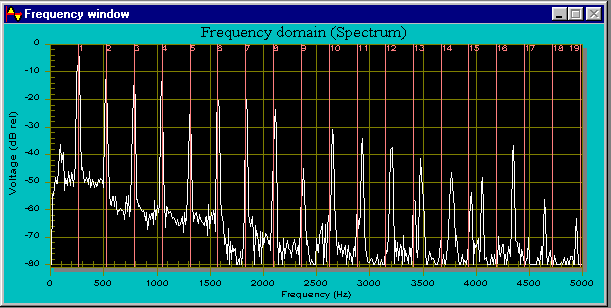
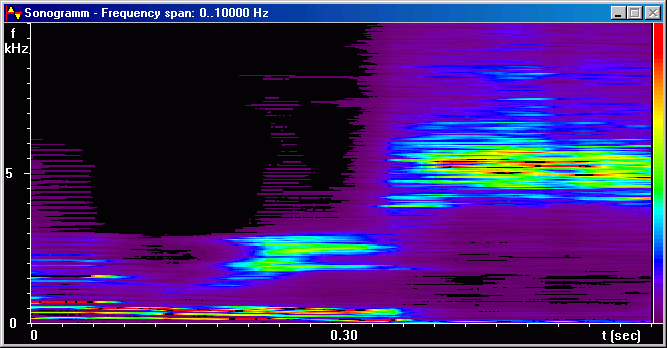
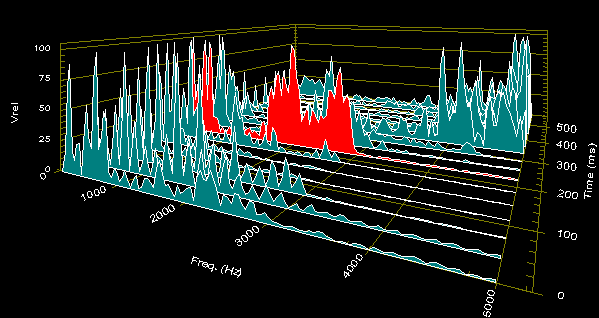
In analyser experiments you capture sound from the sound card or from a WAV file up to several seconds long, select the starting time of the time slice and analyse time and frequency responses. The example shows the spectrum of a piano playing a middle C (262 Hz). The non-harmonic overtones are clearly seen. (Due to the stiffness of the string, the frequencies of the partials are too high.)
Download version 1.15, June 2009: OVERTONE.ZIP
(1.55 MB)
Unpack in a new folder, read README.TXT and start OVERTONE.EXE
(Some firewalls or User Access Control (UAC) may block execution. Give OVERTONE the necessary permissions.
Make sure, that the sound device is not used by another application.)
For more information, send e-mail to address given in README.TXT
Unterrichtseinheit Analyse von Klangspektren von Alain Hauser (in German)
